Filteren

Verfijn je keuze in deze categorie. Zoeken op auteur, ISBN, title of trefwoord? Dat kan eenvoudig via zoeken bovenaan.

Staat
Prijsrange
  • Filter

    Reviews

    Gemiddelde score voor Boek2

    Goede communicatie,

    snelle levering en prima verpakt.

    Extra korting

    %

    Meer boeken is meer korting!

    • Vanaf 5 boeken
    • Vanaf 10 boeken
    • Vanaf 15 boeken
    • Vanaf 20 boeken
    • 5% korting
    • 10% korting
    • 15% korting
    • 20% korting

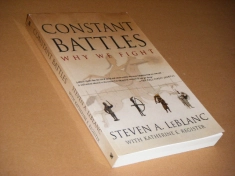
    Constant Battles

    Constant Battles

    Engels. Paperback, als nieuw met kleine beschadiging (vouwtje in de vorm van een ezelsoor)

    With armed conflict in the Persian Gulf now upon us, Harvard archaeologist Steven LeBlanc takes a long-term view of the nature and roots of war, presenting a controversial thesis: The notion of the "noble savage" living in peace with one another and in harmony with nature is a fantasy. In Constant Battles: The Myth of the Peaceful, Noble Savage, LeBlanc contends that warfare and violent conflict have existed throughout human history, and that humans have never lived in ecological balance with nature.

    The start of the second major U.S. military action in the Persian Gulf, combined with regular headlines about spiraling environmental destruction, would tempt anyone to conclude that humankind is fast approaching a catastrophic end. But as LeBlanc brilliantly argues, the archaeological record shows that the warfare and ecological destruction we find today fit into patterns of human behavior that have gone on for millions of years.

    Constant Battles surveys human history in terms of social organization-from hunter gatherers, to tribal agriculturalists, to more complex societies. LeBlanc takes the reader on his own digs around the world -- from New Guinea to the Southwestern U.S. to Turkey -- to show how he has come to discover warfare everywhere at every time. His own fieldwork combined with his archaeological, ethnographic, and historical research, presents a riveting account of how, throughout human history, people always have outgrown the carrying capacity of their environment, which has led to war.

    Ultimately, though, LeBlanc's point of view is reassuring and optimistic. As he explains the roots of warfare in human history, he also demonstrates that warfare today has far less impact than it did in the past. He also argues that, as awareness of these patterns and the advantages of modern technology increase, so does our ability to avoid war in the future.

    Steven A. LeBlanc; Katherine E. Register ;

    € 11,50

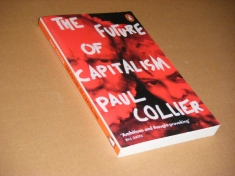
    The Future of Capitalism

    The Future of Capitalism

    Engels, paperback, als nieuw

    *FEATURED IN BILL GATES'S 2019 SUMMER READING RECOMMENDATIONS*

    'This is a beautifully written and important book. Read it' Martin Wolf, Financial Times

    From world-renowned economist Paul Collier, a candid diagnosis of the failures of capitalism and a pragmatic and realistic vision for how we can repair it

    Deep new rifts are tearing apart the fabric of Britain and other Western societies: thriving cities versus the provinces, the highly skilled elite versus the less educated, wealthy versus developing countries. As these divides deepen, we have lost the sense of ethical obligation to others that was crucial to the rise of post-war social democracy. So far these rifts have been answered only by the revivalist ideologies of populism and socialism, leading to the seismic upheavals of Trump, Brexit and the return of the far right in Germany. We have heard many critiques of capitalism but no one has laid out a realistic way to fix it, until now.

    In a passionate and polemical book, celebrated economist Paul Collier outlines brilliantly original and ethical ways of healing these rifts - economic, social and cultural - with the cool head of pragmatism, rather than the fervour of ideological revivalism. He reveals how he has personally lived across these three divides, moving from working-class Sheffield to hyper-competitive Oxford, and working between Britain and Africa, and acknowledges some of the failings of his profession.

    Drawing on his own solutions as well as ideas from some of the world's most distinguished social scientists, he shows us how to save capitalism from itself - and free ourselves from the intellectual baggage of the 20th century.

    These times are in desperate need of Paul Collier's insights. The Future of Capitalism restores common sense to our views of morality, as it also describes their critical role in what makes families, organizations, and nations work. It is the most revolutionary work of social science since Keynes. Let's hope it will also be the most influential - George Akerlof, Nobel Laureate in Economics, 2001

    In this bold work of intellectual trespass, Paul Collier, a distinguished economist, ventures onto the terrain of ethics to explain what's gone wrong with capitalism, and how to fix it. To heal the divide between metropolitan elites and the left-behind, he argues, we need to rediscover an ethic of belonging, patriotism, and reciprocity. Offering inventive solutions to our current impasse, Collier shows how economics at its best is inseparable from moral and political philosophy' - Michael Sandel, author of What Money Can't Buy and Justice

    For thirty years, the centre left of politics has been searching for a narrative that makes sense of the market economy. This book provides it - John Kay, Fellow of St John's College, Oxford and the author of Obliquity and Other People's Money

    For well-to-do metropolitans, capitalism is the gift that goes on giving. For others, capitalism is not working. Paul Collier deploys passion, pragmatism and good economics in equal measure to chart an alternative to the divisions tearing apart so many western countries. -Mervyn King, former Governor of the Bank of England

    Paul Collier ;

    € 6,50

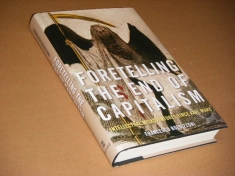
    Foretelling the End of...

    Foretelling the End of Capitalism

    Engels, Gebonden met omslag, als nieuw

    Intellectuals since the Industrial Revolution have been obsessed with whether, when, and why capitalism will collapse. This riveting account of two centuries of failed forecasts of doom reveals the key to capitalism’s durability.
    Prophecies about the end of capitalism are as old as capitalism itself. None have come true. Yet, whether out of hope or fear, we keep looking for harbingers of doom. In Foretelling the End of Capitalism, Francesco Boldizzoni gets to the root of the human need to imagine a different and better world and offers a compelling solution to the puzzle of why capitalism has been able to survive so many shocks and setbacks.


    Capitalism entered the twenty-first century triumphant, its communist rival consigned to the past. But the Great Recession and worsening inequality have undermined faith in its stability and revived questions about its long-term prospects. Is capitalism on its way out? If so, what might replace it? And if it does endure, how will it cope with future social and environmental crises and the inevitable costs of creative destruction? Boldizzoni shows that these and other questions have stood at the heart of much analysis and speculation from the early socialists and Karl Marx to the Occupy Movement. Capitalism has survived predictions of its demise not, as many think, because of its economic efficiency or any intrinsic virtues of markets but because it is ingrained in the hierarchical and individualistic structure of modern Western societies.

    Foretelling the End of Capitalism takes us on a fascinating journey through two centuries of unfulfilled prophecies. An intellectual tour de force and a plea for political action, it will change our understanding of the economic system that determines the fabric of our lives.

    Francesco Boldizzoni ;

    € 16,50

    Black Elk. The life of...

    Black Elk. The life of an American visionary

    Engels. Gebonden met omslag, in zeer goede staat

    Winner of the Society of American Historians' Francis Parkman Prize
    Winner of the PEN / Jacqueline Bograd Weld Award for Biography
    Best Biography of 2016, True West magazine
    Winner of the Western Writers of America 2017 Spur Award, Best Western Biography
    Finalist, National Book Critics Circle Award for Biography
    Long-listed for the Cundill History Prize
    One of the Best Books of 2016, The Boston Globe

    The epic life story of the Native American holy man who has inspired millions around the world

    Black Elk, the Native American holy man, is known to millions of readers around the world from his 1932 testimonial Black Elk Speaks. Adapted by the poet John G. Neihardt from a series of interviews with Black Elk and other elders at the Pine Ridge Reservation in South Dakota, Black Elk Speaks is one of the most widely read and admired works of American Indian literature. Cryptic and deeply personal, it has been read as a spiritual guide, a philosophical manifesto, and a text to be deconstructed—while the historical Black Elk has faded from view.

    In this sweeping book, Joe Jackson provides the definitive biographical account of a figure whose dramatic life converged with some of the most momentous events in the history of the American West. Born in an era of rising violence between the Sioux, white settlers, and U.S. government troops, Black Elk killed his first man at the Little Bighorn, witnessed the death of his second cousin Crazy Horse, and traveled to Europe with Buffalo Bill’s Wild West show. Upon his return, he was swept up in the traditionalist Ghost Dance movement and shaken by the Massacre at Wounded Knee. But Black Elk was not a warrior, instead accepting the path of a healer and holy man, motivated by a powerful prophetic vision that he struggled to understand. Although Black Elk embraced Catholicism in his later years, he continued to practice the old ways clandestinely and never refrained from seeking meaning in the visions that both haunted and inspired him.

    In Black Elk, Jackson has crafted a true American epic, restoring to its subject the richness of his times and gorgeously portraying a life of heroism and tragedy, adaptation and endurance, in an era of permanent crisis on the Great Plains.

    Joe Jackson ;

    € 15,00
    Bezig met laden...
    close

    Favorietenlijst