Filteren

Verfijn je keuze in deze categorie. Zoeken op auteur, ISBN, title of trefwoord? Dat kan eenvoudig via zoeken bovenaan.

Staat
Prijsrange
  • Filter

    Reviews

    Gemiddelde score voor Boek2

    Goede communicatie,

    snelle levering en prima verpakt.

    Extra korting

    %

    Meer boeken is meer korting!

    • Vanaf 5 boeken
    • Vanaf 10 boeken
    • Vanaf 15 boeken
    • Vanaf 20 boeken
    • 5% korting
    • 10% korting
    • 15% korting
    • 20% korting

    The Mathematical...

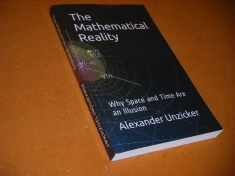
    The Mathematical Reality. Why Space and Time Are an Illusion

    Engelstalige pocket, geen naam voorin, mooie rechte rug nog, zo goed als nieuw.

    The discovery of fundamental laws of nature has influenced the fate of Homo sapiens more than anything else. Has modern physics already understood these laws? Many puzzles formulated by Albert Einstein or Paul Dirac are still unsolved today, in particular the meaning of fundamental constants. In this book, it is argued that a rational description of nature must do without any constants. A thorough analysis of the history of physics leads to the conclusion that there is a serious problem with what have been considered the basis of reality for centuries: Space and time. These may be the most accessible concepts for human perception, but are probably unsuitable for a basic understanding of nature. A methodological and historical analysis shows, however, that the underlying problem of physics is deep, unexpected and fatal: the concepts of space and time themselves, the basis of science since Newton, could be fundamentally inappropriate for the description of reality, although-or precisely because-they are so easily accessible to human perception. A new understanding of reality can only arise from mathematics. By exploring the three-dimensional unit sphere, which could replace the concepts of space and time, the author presents a mathematical vision that points the way to a new understanding of reality.

    Alexander Unzicker;

    € 8,50

    Science

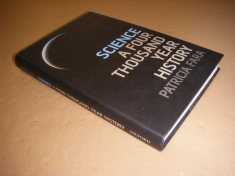
    Science

    Èngels. Gebonden met omslag. In sommige hoofdstukken komen potloodonderstrepingen voor. Verder is het een zeer gaaf exemplaar. 

    In Science, Patricia Fara rewrites science's past to provide new ways of understanding and questioning our modern technological society. Aiming not just to provide information but to make people think, this unique book explores how science has become so powerful by describing the financial interests and imperial ambitions behind its success.
    Sweeping through the centuries from ancient Babylon right up to the latest hi-tech experiments in genetics and particle physics, Fara's book also ranges internationally, challenging notions of European superiority by emphasising the importance of scientific projects based around the world, including revealing discussions of China and the Islamic Empire alongside the more familiar stories about Copernicus's sun-centered astronomy, Newton's gravity, and Darwin's theory of evolution. We see for instance how Muslim leaders encouraged science by building massive libraries, hospitals, and astronomical observatories and we rediscover the significance of medieval Europe--long overlooked--where, surprisingly, religious institutions ensured science's survival, as the learning preserved in monasteries was subsequently developed in new and unique institutions: universities. Instead of focussing on esoteric experiments and abstract theories, she explains how science belongs to the practical world of war, politics and business. And rather than glorifying scientists as idealized heroes, she tells true stories about real people--men (and some women) who needed to earn their living, who made mistakes, and who trampled down their rivals.
    Finally, this provocative volume challenges scientific supremacy itself, arguing that science is successful not because it is always indubitably right, but because people have said that it is right. Science dominates modern life, but perhaps the globe will be better off by limiting science's powers and undoing some of its effects.
    "Dismantling popular myths, taking a truly global view and dispensing with false idols, Fara's highly readable survey of science's histories is a breath of fresh air. She unerringly pinpoints the defining moods of each age, treating the past with respect and the present with discernment. This wonderfully literate book tells a story that is far, far more interesting than the tidy fictions of hindsight." -- Philip Ball, Consultant Editor of Nature
    "It's been a very long time since any reputable historian of science had the desire, the knowledge, or the nerve to undertake a book like this-- an attempt to survey the development of science from Antiquity to the present, notably including non-European materials. Patricia Fara has succeeded: Science is an elegant and compact creative synthesis of the piecemeal researches of generations of academic historians. It deserves the widest possible readership." - Steven Shapin, Professor of the History of Science, Harvard, and author of The Scientific Revolution

    Patricia Fara lectures in the History and Philosophy of Science at the University of Cambridge and is the Senior Tutor of Clare College. She is the author of numerous books, including Fatal Attraction: Magnetic Mysteries of the Enlightenment and Newton: The Making of Genius. Her writing has appeared in History Today, New Scientist, Nature, The Times and New Statesman, and she writes a regular column on scientific portraits for Endeavour.
    Books by the same author Fatal Attraction: Magnetic Mysteries of the Enlightenment by Patricia Fara. Published: 2005 Publisher: Icon Books Price: L9.99 Pandora's Breeches: Women, Science and Power in the Enlightenment by Patricia Fara. Published: 2004 Publisher: Pimlico Price: L12.99 Sex, Botany and Empire; the Stories of Carl Linnaeus and Joseph Banks by Patricia Fara. Published: 2003 Publisher: Icon Books Price: L6.99 Newton: the Making of Genius by Patricia Fara. Published: 2002 Publisher: Macmillan Price: L20 An Entertainment for Angels: Electricity in the Enlightenment by Patricia Fara. Publish

    Patricia Fara ;

    € 15,00

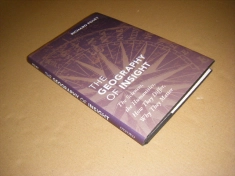
    The Geography of Insight

    The Geography of Insight

    Engelstalige uitgave, gebonden met stofomslag, als nieuw

    The humanities and the sciences face challenging times, each in their own way. The humanities suffer shrinking enrollments and budgets, and are perceived by some as irrelevant in a changing economy. The sciences face a political climate that disrespects academic expertise and challenges settled debates. Meanwhile age-old disputes about their spheres of knowledge continue: does scientific knowledge subsume that of the humanities? Are their forms of knowledge complementary, or ultimately at odds?

    Richard Foley, a philosopher of knowledge and the former Dean of Arts and Sciences at New York University, here provides a concise and accessible overview of what the overarching goals of these disciplines are, relative to one another, and what kind of knowledge they aim to produce. His fundamental argument is that the sciences aim at insights that ideally are not limited to particular locations or times and are also perspective-free and wholly descriptive, whereas the humanities appropriately seek insights about specific locations and times, with the insights being perspective-based and having evaluative as well as descriptive elements. He also finds these two spheres of knowledge to be complementary in the search for understanding of our world and the human condition. The ultimate goal of Foley's investigation however is an eloquent defense and celebration of the culture of academic research. In an era of sound-bites and tweet-length falsehoods, this culture values and supports long-term intellectual achievements for the good of humanity - produced with hard work, dedication, and patience. The Geography of Insight is essential reading for readers both inside and outside of the academy.

    Richard Foley ;

    € 20,00

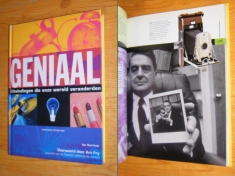
    Geniaal. Uitvindingen...

    Geniaal. Uitvindingen die onze wereld veranderden

    Grote, dikke hardback in goede staat. Cover licht verkleurd. Geen stofomslag. Geillustreerd.

    Geniaal is een onthullende presentatie van de gebruiksvoorwerpen die op velerlei terrein richting hebben gegeven aan de ontwikkeling van het leven van de mens - van voorwerpen in het huishouden tot medische en technische doorbraken. Geniaal onthult het genie achter de paperclip, de spuitbus en de straalmotor. Voorwerpen van uiteenlopende vorm en maat die we nu als vanzelfsprekend beschouwen worden uitvoerig beschreven als ware innovaties in hun tijd.
    Het verhaal van elke uitvinding wordt in detail uitgewerkt. De ontwikkeling van haar prille begin tot huidige vorm, de rivalen die ervoor streden om het idee over te nemen of nog verder te ontwikkelen, de fascinerende levens van de uitvinders zelf. De uitvindingen die het uiteindelijk haalden staan gepresenteerd naast die wonderlijke en wonderschone ideeën die uiteindelijk in de vergetelheid zijn geraakt.
    In het huishouden: strijkijzer, magnetron, koelkast, wegwerpluier, veiligheidsspeld, rits, naaimachine, haardroger, waterkoker, papieren zakdoek, lipstick.
    Op kantoor: schrijfmachine, kopieermachine, airconditioner, fax, kasregister, computer met muis, ballpoint, paperclip, rolodex, telefoon, post-it.
    Bij de dokter: betablocker, gehoorapparaat, intelligentietest, wegwerpinjectienaald, CAT-scanner, kunsthart, insuline, laser, pleister de pil.
    Vervoer: hoovercraft, luchtrem, straalmotor, black box, parkeermeter, luchtband, radar, locomotief, parachute, onderzeeër, teerweg, verkeerslicht, inductiemotor.
    Technisch: geigerteller, BAR-code, batterij, polytheen, mitrailleur, microchip, kevlar, transistor, geweer, logarithmen, kettingzaag.
    Vrije tijd: monopoly, meccano, kruiswoordpuzzel, golfspel, roller skates, radio, televisie, rolfilmcamera, workmate, tennis, polaroid-camera.
    Ian Harrison;

    € 5,00

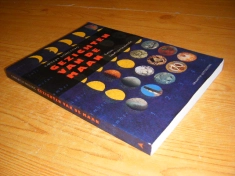
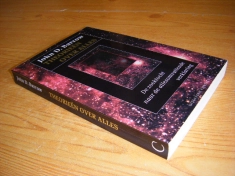
    Theorieen over alles

    Theorieen over alles

    Paperback in goede staat. Leesvouwtje in rug.
    De fascinatie voor het heelal is door de eeuwen heen altijd erg groot geweest. Vroeger bogen vooral theologen en filosofen zich over de vragen hoe het heelal ontstaan is en of We met het doorgronden van het heelal iets kunnen zeggen over de toekomst. Nu is de speurtocht naar een allesomvattende verklaring de essentie geworden van onze theorieën over het heelal. Hedendaagse natuurkundigen denken dat ze de sleutel tot het heelal hebben gevonden en dat die ontdekking zal leiden naar een Theorie Over Alles: een eenduidig, allesomvattend beeld van de natuurwetten waaruit met een ijzeren logica alles te verklaren valt.
    Is die gedachte niet al te optimistisch? Kunnen onze theorietjes en de berekeningen van door mensen ontwikkelde computers ons werkelijk alles vertellen over het heelal? John D. Barrow zet in dit meeslepende boek uiteen wat een Theorie Over Alles inhoudt, wat de beperkingen zijn en wat we ervan kunnen leren over het heelal. Hij onderzoekt de essentiële ingrediënten van zo'n theorie en geeft aan wat de voorwaarden zijn: we moeten bereid zijn onbetreden paden te bewandelen; we moeten er rekening mee houden dat het heelal rommelig en gecompliceerd is; en we moeten voor ogen houden dal we beperkt zijn door de vragen die we stellen en door de informatie die we aan kunnen. Maar duidelijk is dat de sleutel tot een Theorie Over Alles in de opmerkelijke capaciteiten van de wiskundigen ligt: alleen zij kunnen de basisprincipes van het universum uitleggen in een taal die de menselijke geest kan begrijpen en kan manipuleren.

    John D. Barrow;

    € 4,00
    Bezig met laden...
    close

    Favorietenlijst