Filteren

Verfijn je keuze in deze categorie. Zoeken op auteur, ISBN, title of trefwoord? Dat kan eenvoudig via zoeken bovenaan.

Staat
Prijsrange
  • Filter

    Reviews

    Gemiddelde score voor Boek2

    Goede communicatie,

    snelle levering en prima verpakt.

    Extra korting

    %

    Meer boeken is meer korting!

    • Vanaf 5 boeken
    • Vanaf 10 boeken
    • Vanaf 15 boeken
    • Vanaf 20 boeken
    • 5% korting
    • 10% korting
    • 15% korting
    • 20% korting

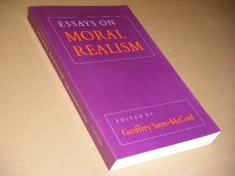
    Essays on Moral Realism

    Essays on Moral Realism

    Engelstalige paperback, in zeer goede staat. Wel enige leeslijnen op de rug. 

    For the greater part of this century, most philosophers and social scientists have eschewed moral realism. According to their view, moral facts cannot be accommodated by a suitably scientific picture of the world. However, recent developments in moral theory, the philosophy of science, and the philosophy of language have undermined the standard arguments against moral realism and have led many to maintain that there are powerful reasons for believing in moral facts. As a result, moral realism is enjoying renewed vitality, while the arguments against it have of necessity become more sophisticated and penetrating.

    This collection of influential essays illustrates the range, depth, and importance of moral realism, the fundamental issues it raises, and the problems it faces. Geoffrey Sayre-McCord has chosen accessible, rigorous, and thought-provoking papers, all of which are rich enough to encourage and reward several readings and careful study. In addition, the volume strikes a balance between wide-ranging papers that advance a barrage of arguments, and more focused papers that develop a few arguments in great detail. What emerges is a comprehensive overview of the moral realism debate that exhibits the scope, as well as the intricacies, of the arguments marshaled on all sides. It will be welcomed by scholars and students of philosophy, the social sciences, and political science.

    CONTRIBUTORS: A. J. Ayer, Simon Blackburn, Richard Boyd, Gilbert

    Harman, Jonathan Lear,' J. L. Mackie, John McDowell, Mark Platts,

    Geoffrey Sayre-McCord, Nicholas Sturgeon, David Wiggins, Bernard

    Williams.
    Geoffrey Sayre-McCord ;

    € 10,00

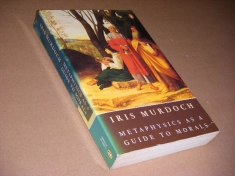
    Metaphysics as a Guide...

    Metaphysics as a Guide to Morals

    Engels. Paperback, in goede staat
    Dame Iris Murdoch, who has written several works of philosophy as well as twenty-four distinguished novels, now crowns her philosophic quest with a book that asks many questions and reflects on the essential aspects of the great subject: moral philosophy. Among her concerns are the roles literature, politics, art, and science play in the search for morality in a world that avoids the issue. What is morality, after all, Murdoch asks. Is it important? Is it true? Can it be taught in schools? Is it the very basis of our existence, or is it just one of many peripheral matters? A main theme of this profound work concerns religion and its relation to morals, to moral philosophy, and to the great metaphysical systems which have supported it in the past. These are questions that concern us all, as we are driven to reflect upon the relation between religion and morals and upon the various conceptions of what religion is. Iris Murdoch believes it is time for a dialogue between moral philosophy and a demythologizing theology. She casts fresh light on our great western metaphysicians, Plato and Kant. She writes that philosophy is now in danger of being fragmented into psychology, sociology, anthropology, and other peripheral disciplines. Some universities are closing their philosophy departments. Moral philosophy (ethics), if considered at all, tends to be segregated as a small, special subject. Technology, so beneficial in innumerable ways, displays to us a vast, colorful world of facts within which "moral value" may appear as a little particular item. In her lucid and tightly reasoned "reflections," Dame Iris Murdoch constructs a warning that the survival of philosophy with its persistent ever-new attempts to seek "foundations" is more than ever essential, when the very question of "human being" is at stake. A grand work by one of the most distinguished thinkers of our time.
    Iris Murdoch ;

    € 10,00

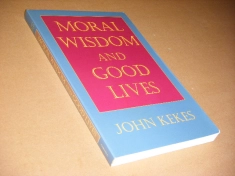
    Moral Wisdom and Good...

    Moral Wisdom and Good Lives

    Engels. Paperback, in goede staat.

    In this profound and yet accessible book, John Kekes discusses moral wisdom: a virtue essential to living a morally good and personally satisfying life. He advances a broad, nontechnical argument that considers the adversities inherent in the human condition and assists in the achievement of good lives.

    The possession of moral wisdom, Kekes asserts, is a matter of degree: more of it makes lives better, less makes them worse. Exactly what is moral wisdom, however, and how should it be sought? Ancient Greek and medieval Christian philosophers were centrally concerned with it. By contrast, modern Western sensibility doubts the existence of a moral order in reality; and because we doubt it, and have developed no alternatives, we have grown dubious about the traditional idea of wisdom.

    Kekes returns to the classical Greek sources of Western philosophy to argue for the contemporary significance of moral wisdom. He develops a proposal that is eudaimonistic--secular, anthropocentric, pluralistic, individualistic, and agonistic. He understands moral wisdom as focusing on the human effort to create many different forms of good lives. Although the approach is Aristotelian, the author concentrates on formulating and defending a contemporary moral ideal. The importance of this ideal, he shows, lies in increasing our ability to cope with life's adversities by improving our judgment.

    In chapters on moral imagination, self-knowledge, and moral depth, Kekes calls attention to aspects of our inner life that have been neglected because of our cultural inattention to moral wisdom. He discusses these inner processes through the tragedies of Sophocles, which can inspire us with their enduring moral significance and help us to understand the importance of moral wisdom to living a good life.

    John Kekes ;

    € 10,00

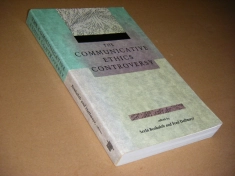
    The Communicative...

    The Communicative Ethics Controversy

    Engels. paperback, leeslijn op de rug, in goede staat

    This timely reader in moral philosophy addresses a controversy that strongly affected recent European reflections on the relevance of ethics for theories of democratic institutions and democratic legitimacy. The debate centers around the idea of a communicative ethics as articulated by J�rgen Habermas and Karl-Otto Apel, and it is representative both of recent attempts to bridge the gap between Continental and Anglo-American philosophy and of the turn to language that has characterized much of recent philosophy.The Communicative Ethics Controversy illustrates philosophical dialogue in action, moving from theses to counterarguments to rejoinders. Theoretical statements by Habermas, Apel, and two of their leading students, Dietrich B�hler and Robert Alexy, are followed by a series of five arguments by their leading critics, who represent viewpoints ranging from Kantian idealism to Wittgensteinian ordinary-language theory. Fred Dallmayr's introduction and Seyla Benhabib's incisive conclusion place the debate in perspective, bringing it up to date and relating it to the Anglo-American context.Seyla Benhabib is Associate Professor of Philosophy and Women's Studies at the State University of New York, Stony Brook. Fred Dallmayr is Packey Dee Professor of Government at the University of Notre Dame.Contributors: Robert Alexy. Karl-Otto Apel. Seyla Benhabib. Dietrich Bohler. Jurgen Habermas. Otfried Hoffe. KarlHeinz Ilting. Hermann Lubbe. Herbert Schnadelbach. Albrecht Wellmer.

    Seyla Benhabib; Fred Reinhard Dallmayr ;

    € 15,00

    Splitting the...

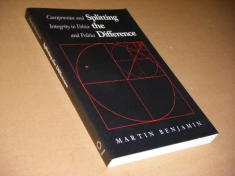
    Splitting the Difference. Compromise and Integrity in Ethics and Politics

    ENGELS, paperback, in zeer goede staat

    Politics is often characterized as the "art of compromise"—the implication being that compromise is desirable and that insight, imagination, discipline, and skill are all necessary for a satisfactory and successful compromise. Compromise in ethics, however, is quite another matter: there, it is usually regarded as a sign of weakness or lack of integrity. From Socrates and Sir Thomas More to Gandhi, Elizabeth Cady Stanton, and Martin Luther King, Jr., we revere these men and women not only for the nature of their convictions but also for their unwavering refusal to compromise.

    Does this point to an important difference between politics and ethics? Martin Benjamin here explores, in the first book-length treatment, the surprisingly rich and complex notion of compromise and integrity in ethics and politics. With wide-ranging examples drawn from Tolstoy to Ralph Nader and from a variety of medical and bioethical cases Benjamin presents in a clear, straightforward fashion an examination of the interplay between compromise and integrity.

    In the process, Benjamin tackles tough questions—the relationship between practical and theoretical ethics, what compromise means for ethical theory, how moral judgments affect compromise, and whether it is possible to compromise without being compromised. In the final chapter Benjamin explores the possibility of political compromise in a matter of great ethical significance—abortion.

    Martin Benjamin ;

    € 10,00
    Bezig met laden...
    close

    Favorietenlijst