Filteren

Verfijn je keuze in deze categorie. Zoeken op auteur, ISBN, title of trefwoord? Dat kan eenvoudig via zoeken bovenaan.

Staat
Prijsrange
  • Filter

    Reviews

    Gemiddelde score voor Boek2

    Goede communicatie,

    snelle levering en prima verpakt.

    Extra korting

    %

    Meer boeken is meer korting!

    • Vanaf 5 boeken
    • Vanaf 10 boeken
    • Vanaf 15 boeken
    • Vanaf 20 boeken
    • 5% korting
    • 10% korting
    • 15% korting
    • 20% korting

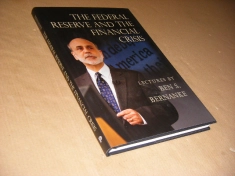
    The Federal Reserve...

    The Federal Reserve and the Financial Crisis

    Engels. In linnen gebonden, in zeer goede staat

    Ben Bernanke's history of the Federal Reserve and its response to the 2008 financial crisis

    In 2012, Ben Bernanke, chairman of the U.S. Federal Reserve, gave a series of lectures about the Federal Reserve and the 2008 financial crisis, as part of a course at George Washington University on the role of the Federal Reserve in the economy. In this unusual event, Bernanke revealed important background and insights into the central bank's crucial actions during the worst financial crisis since the Great Depression. Taken directly from these historic talks, The Federal Reserve and the Financial Crisis offers insight into the guiding principles behind the Fed's activities and the lessons to be learned from its handling of recent economic challenges.

    Bernanke traces the origins of the Federal Reserve, from its inception in 1914 through the Second World War, and he looks at the Fed post-1945, when it began operating independently from other governmental departments such as the Treasury. During this time the Fed grappled with episodes of high inflation, finally tamed by then-chairman Paul Volcker. Bernanke also explores the period under his predecessor, Alan Greenspan, known as the Great Moderation. Bernanke then delves into the Fed's reaction to the recent financial crisis, focusing on the central bank's role as the lender of last resort and discussing efforts that injected liquidity into the banking system. Bernanke points out that monetary policies alone cannot revive the economy, and he describes ongoing structural and regulatory problems that need to be addressed.

    Providing first-hand knowledge of how problems in the financial system were handled, The Federal Reserve and the Financial Crisis will long be studied by those interested in this critical moment in history.

    Ben Bernanke ;

    € 11,50

    Never Enough....

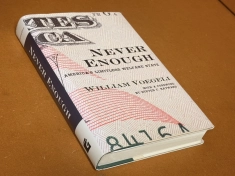
    Never Enough. America's Limitless Welfare State

    Forse Engelstalige hardcover met stofomslag, als nieuw, Like NEW.

    Since the beginning of the New Deal, American liberals have insisted that the government must do more--much more--to help the poor, to increase economic security, to promote social justice and solidarity, to reduce inequality, and to mitigate the harshness of capitalism. Nonetheless, liberals have never answered, or even acknowledged, the corresponding question: What would be the size and nature of a welfare state that was not contemptibly austere, that did not urgently need new programs, bigger budgets, and a broader mandate? Even though the federal government's outlays have doubled every eighteen years since 1940, liberal rhetoric is always addressed to a nation trapped in Groundhog Day, where every year is 1932, and none of the existing welfare state programs that spend tens of billions of dollars matter, or even exist.

    Never Enough explores the roots and consequences of liberals' aphasia about the welfare state's ultimate size. It assesses what liberalism's lack of a limiting principle says about the long-running argument between liberals and conservatives, and about the policy choices confronting America in a new century. Never Enough argues that the failure to speak clearly and candidly about the welfare state's limits has grave policy consequences. The worst result, however, is the way it has jeopardized the experiment in self-government by encouraging Americans to regard their government as a vehicle for exploiting their fellow-citizens, rather than as a compact for respecting one another's rights and safeguarding the opportunities of future generations.

    William J. Voegeli ;

    € 11,50

    The Richest Man Who...

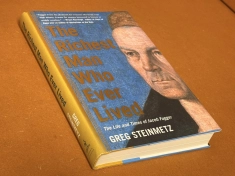
    The Richest Man Who Ever Lived. The Life and Times of Jacob Fugger

    Forse Engelstalige hardcover met stofomslag, als nieuw, Like NEW.

    Most people become rich by spotting opportunities, pioneering new technologies, or besting opponents in negotiations. Fugger did all that, but he had an extra quality that allowed him to rise even higher: nerve. In an era when kings had unlimited power, Fugger had the nerve to stare down heads of state and ask them to pay back their loans—with interest. It was this coolness and self-assurance, along with his inexhaustible ambition, that made him not only the richest man ever, but a force of history as well. Before Fugger came along it was illegal under church law to charge interest on loans, but he got the Pope to change that. He also helped trigger the Reformation and likely funded Magellan’s circumnavigation of the globe. His creation of a news service, which gave him an information edge over his rivals and customers, earned Fugger a footnote in the history of journalism. And he took Austria’s Habsburg family from being second-tier sovereigns to rulers of the first empire where the sun never set.

    The ultimate untold story, The Richest Man Who Ever Lived is more than a tale about the richest and most influential businessman of all time. It is a story about palace intrigue, knights in battle, family tragedy and triumph, and a violent clash between the 1 percent and everybody else. To understand our financial system and how we got it, it pays to understand Jacob Fugger.

    Greg Steinmetz;

    € 16,50

    The Darwin Economy....

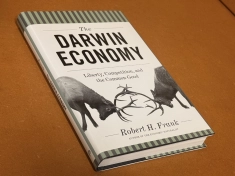
    The Darwin Economy. Liberty, Competition, and the Common Good

    Engelstalige hardcover met stofomslag, als nieuw, Like NEW.

    Who was the greater economist--Adam Smith or Charles Darwin? The question seems absurd. Darwin, after all, was a naturalist, not an economist. But Robert Frank, New York Times economics columnist and best-selling author of The Economic Naturalist, predicts that within the next century Darwin will unseat Smith as the intellectual founder of economics. The reason, Frank argues, is that Darwin's understanding of competition describes economic reality far more accurately than Smith's. And the consequences of this fact are profound. Indeed, the failure to recognize that we live in Darwin's world rather than Smith's is putting us all at risk by preventing us from seeing that competition alone will not solve our problems.

    Smith's theory of the invisible hand, which says that competition channels self-interest for the common good, is probably the most widely cited argument today in favor of unbridled competition--and against regulation, taxation, and even government itself. But what if Smith's idea was almost an exception to the general rule of competition? That's what Frank argues, resting his case on Darwin's insight that individual and group interests often diverge sharply. Far from creating a perfect world, economic competition often leads to "arms races," encouraging behaviors that not only cause enormous harm to the group but also provide no lasting advantages for individuals, since any gains tend to be relative and mutually offsetting.

    The good news is that we have the ability to tame the Darwin economy. The best solution is not to prohibit harmful behaviors but to tax them. By doing so, we could make the economic pie larger, eliminate government debt, and provide better public services, all without requiring painful sacrifices from anyone. That's a bold claim, Frank concedes, but it follows directly from logic and evidence that most people already accept.

    Robert H. Frank;

    € 11,50

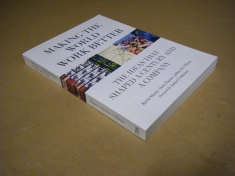
    Making the World Work...

    Making the World Work Better

    Engels. Paperback, vrijwel als nieuw

    Thomas J Watson Sr's motto for IBM was THINK, and for more than a century, that one little word worked overtime. In Making the World Work Better: The Ideas That Shaped a Century and a Company , journalists Kevin Maney, Steve Hamm, and Jeffrey M. O'Brien mark the Centennial of IBM's founding by examining how IBM has distinctly contributed to the evolution of technology and the modern corporation over the past 100 years.

    The authors offer a fresh analysis through interviews of many key figures, chronicling the Nobel Prize-winning work of the company's research laboratories and uncovering rich archival material, including hundreds of vintage photographs and drawings. The book recounts the company's missteps, as well as its successes. It captures moments of high drama - from the bet-the-business gamble on the legendary System/360 in the 1960s to the turnaround from the company's near-death experience in the early 1990s.

    The authors have shaped a narrative of discoveries, struggles, individual insights and lasting impact on technology, business and society. Taken together, their essays reveal a distinctive mindset and organizational culture, animated by a deeply held commitment to the hard work of progress. IBM engineers and scientists invented many of the building blocks of modern information technology, including the memory chip, the disk drive, the scanning tunneling microscope (essential to nanotechnology) and even new fields of mathematics. IBM brought the punch-card tabulator, the mainframe and the personal computer into the mainstream of business and modern life. IBM was the first large American company to pay all employees salaries rather than hourly wages, an early champion of hiring women and minorities and a pioneer of new approaches to doing business--with its model of the globally integrated enterprise. And it has had a lasting impact on the course of society from enabling the US Social Security System, to the space program, to airline reservations, modern banking and retail, to many of the ways our world today works.

    The lessons for all businesses - indeed, all institutions - are powerful: To survive and succeed over a long period, you have to anticipate change and to be willing and able to continually transform. But while change happens, progress is deliberate. IBM - deliberately led by a pioneering culture and grounded in a set of core ideas - came into being, grew, thrived, nearly died, transformed itself... and is now charting a new path forward for its second century toward a perhaps surprising future on a planetary scale.

    Kevin Maney; Steve Hamm; Jeffrey M. OBrien ;

    € 7,50

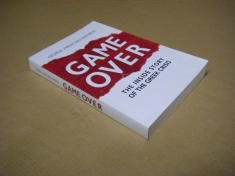
    Game Over. The inside...

    Game Over. The inside story of the Greek crisis

    Engels. Naam voorin. Verder in zeer goede staat

    In this real-life political thriller, former Finance Minister George Papaconstantinou tells the inside story of the six years during which the Greek drama changed Europe and riveted the world. It is the story of a country forced by past mistakes into unprecedented actions with enormously painful consequences. A story about the people who shaped events by trying to respond to rapidly evolving circumstances often beyond their control. About decisions - good and bad, right and wrong - taken in official and behind-the-scenes gatherings in Brussels, Berlin, Frankfurt, Paris, London, New York, Washington and Athens; in Luxembourg châteaux courtyards, Davos kitchens and Bilderberg gatherings; in elegant offices and dreary basement meetings rooms.

    The story begins in October 2009 in Athens, when after a landslide victory, the new government shocks the world by announcing a fiscal deficit of an alarming size, until then kept secret. The "accident waiting to happen" since the launch of the Euro is finally here - but there are no contingency plans to deal with it, and the systemic nature of the crisis is initially not fully appreciated. When a bailout mechanism is finally put together, it fails to convince markets that the Eurozone will do whatever it takes to prevent the bankruptcy of one of its members. The bluff is called, and Greece is forced to apply in May 2010 for a massive loan from the Eurozone and the IMF, and accept a harsh austerity program. As the first loan installment arrives one day before the country declares default, the first wage and pension cuts produce riots and social unrest which leave three people dead.

    But the crisis is not over - it mutates. Delays in recognizing the problem and mistakes in the way it is dealt with end up opening the gates of hell for the entire Eurozone. Ireland is forced into a bailout - Portugal follows. And in Greece, the initial good program results are soon swept away by the concern in international markets that Greece might exit the Eurozone. Meanwhile the continuing austerity leads to an ever-deeper recession, rapidly rising unemployment, increasing social tensions, and real suffering.

    Six years down the road since the crisis erupted, Greece is in its third bailout, still in a severe social and economic crisis, and there are so many questions. Were other solutions available? Should Greece have threatened to default in order to get a better deal? Should there have been debt relief from the beginning? Would Greece have been better off if it had left the Euro? Has Greece saved the Euro but not itself? The book addresses these questions with the eye of someone at the heart of decision-making during the crisis.

    This is the breath-taking story of an incredible period, told for the first time not by an outside observer, but by one of its protagonists.
    George Papaconstantinou ;

    € 10,00

    Deep Impact when it...

    Deep Impact when it Matters Most

    EW Economie-lezing 2022. Paperback, in zeer goede staat

    Nancy McKinstry, bestuursvoorzitter van informatieleverancier Wolters Kluwer, over de razendsnelle technologische veranderingen, de daaruit voortvloeiende ethische vraagstukken en het belang van diversiteit en inclusiviteit voor ondernemingen als Wolters Kluwer.00Dit boek bevat de Nederlandse vertaling plus het Engelse origineel - uitgebreid en geannoteerd - van de vijfde EW Economie-lezing die de bestuursvoorzitter van informatieleverancier Wolters Kluwer Nancy McKinstry donderdagavond 10 maart 2022 heeft uitgesproken in debatcentrum De Rode Hoed in Amsterdam.00De Amerikaanse McKinstry (63) is sinds september 2003 CEO en voorzitter van de raad van bestuur van informatieleverancier Wolters Kluwer. Toonaangevende media hebben haar herhaaldelijk een van de machtigste vrouwen in het bedrijfsleven genoemd. Ze staat op de lijst van Fortune International?s Most Powerful Women in Business en is opgenomen in HBR?s 2019-lijst van ?de meest effectieve CEO?s van de wereld?.00In de jaarlijkse EW Economie-lezing geven ondernemers, bestuurders van bedrijven en economen hun visie op ontwikkelingen in de samenleving. De EW Economie-lezing is eerder uitgesproken door Ben van Beurden (Shell), Pieter Elbers (KLM), Frans van Houten (Philips) en Jacco Vonhof (MKB-Nederland). Nancy McKinstry vertegenwoordigt bij dit eerste lustrum een dubbele primeur: zij is de eerste vrouw én de eerste niet-Nederlander die de EW Economie-lezing verzorgt.0.

    Nancy McKinstry ;

    € 5,00

    The Invisible Heart....

    The Invisible Heart. Economics and Family Values

    Engelstalige paperback in zeer goede staat. Geen naam voorin, rechte rug. 

    There has been much talk about family values in recent years, but little examination of the economic forces that are exploding family life and limiting the caregiving that families can provide. As Folbre points out in her provocative and insightful new book, every society must confront the problem of balancing self-interested pursuits with care for others--including children, the elderly, and the infirm. Historically, most societies enjoyed an increased supply of care by maintaining strict limits on women's freedom. But as these limits happily and inevitably give way, there are many consequences for those who still need care.

    Using the image of "the invisible heart" to evoke the forces of compassion that must temper the forces of self-interest, Folbre argues that if we don't establish a new set of rules defining our mutual responsibilities for caregiving, the penalties suffered by the needy--our very families--will increase. Intensified economic competition may drive altruism and families out of business.
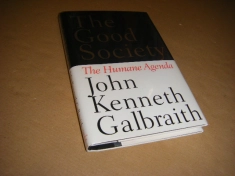
    A leading feminist economist, Nancy Folbre writes in a lively, personal style--Molly Ivins cheek-to-cheek with John Kenneth Galbraith--and develops a distinctive approach to the economics of care. Unlike others who praise family values, Folbre acknowledges the complicated relationship between women and altruism. Her book offers new interpretations of such policy issues as welfare reform, school finance, and progressive taxation, and it confronts the challenges of globalization, outlining strategies for developing an economic system that rewards both individual achievement and care for others.
    Nancy Folbre ;

    € 12,50

    Mismeasuring Our...

    Mismeasuring Our Lives. Why GDP Doesn't Add Up

    Engelstalige paperback in goede staat. Klein stickertje op de rug en kaft geplakt met de tekst Used, maar in werkelijkheid is daar niets van te zien en lijkt het boek verder als nieuw. By the Commission on the Measurement of Economic Performance and Social Progress (France)

    In February of 2008, amid the looming global financial crisis, President Nicolas Sarkozy of France asked Nobel Prize-winning economists Joseph Stiglitz and Amartya Sen, along with the distinguished French economist Jean Paul Fitoussi, to establish a commission of leading economists to study whether Gross Domestic Product (GDP)--the most widely used measure of economic activity--is a reliable indicator of economic and social progress. The Commission was given the further task of laying out an agenda for developing better measures.

    Mismeasuring Our Lives is the result of this major intellectual effort, one with pressing relevance for anyone engaged in assessing how and whether our economy is serving the needs of our society. The authors offer a sweeping assessment of the limits of GDP as a measurement of the well-being of societies--considering, for example, how GDP overlooks economic inequality (with the result that most people can be worse off even though average income is increasing); and does not factor environmental impacts into economic decisions.

    In place of GDP, Mismeasuring Our Lives introduces a bold new array of concepts, from sustainable measures of economic welfare, to measures of savings and wealth, to a "green GDP." At a time when policymakers worldwide are grappling with unprecedented global financial and environmental issues, here is an essential guide to measuring the things that matter.

    Joseph E. Stiglitz; Amartya Sen; Jean-Paul Fitoussi;

    € 7,50
    Bezig met laden...
    close

    Favorietenlijst