Filteren

Verfijn je keuze in deze categorie. Zoeken op auteur, ISBN, title of trefwoord? Dat kan eenvoudig via zoeken bovenaan.

Staat
Prijsrange
  • Filter

    Reviews

    Gemiddelde score voor Boek2

    Goede communicatie,

    snelle levering en prima verpakt.

    Extra korting

    %

    Meer boeken is meer korting!

    • Vanaf 5 boeken
    • Vanaf 10 boeken
    • Vanaf 15 boeken
    • Vanaf 20 boeken
    • 5% korting
    • 10% korting
    • 15% korting
    • 20% korting

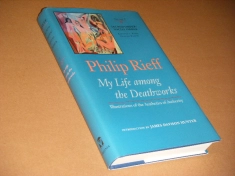
    My Life Among the...

    My Life Among the Deathworks

    Engels. Gebonden met stofomslag, in goede staat

    With My Life among the Deathworks: Illustrations of the Aesthetics of Authority, the renowned cultural theorist and Freud scholar Philip Rieff inaugurates a trilogy that signals the summation of his scholarly lifework. With this series, Sacred Order/Social Order, to be published in consecutive volumes, Rieff both continues and supersedes the lines of thought that characterize the earlier, influential works upon which his reputation was forged. Readers familiar with Rieff's distinctive oeuvre will recognize central themes and find final recitations on the cultural impact of Freud and his creation "psychological man" or "the therapeutic," which Rieff here renames the "new man." Whether conversant with Rieff's work or new to its unique interpretive power, readers of Sacred Order/Social Order will discover a series of provocative insights, illuminated by Rieff's wide-ranging expositions, theoretical advances, and stylistic innovations.

    In this first volume, Rieff articulates a comprehensive, typological theory of Western culture. Using visual illustrations and unique juxtapositions, he displays remarkable erudition in drawing from such disciplines as sociology, history, literature, poetry, music, plastic arts, and film; he contrasts the changing modes of spiritual and social thought that have struggled for dominance throughout Western history. Our modern culture--to Rieff's mind only the "third" type in western history--is the object of his deepest scrutiny, described here as morally ruinous, death-affirming rather than life-affirming, and representing an unprecedented attempt to create a culture completely devoid of any concept of the sacred.

    For Rieff, culture represents the "form of fighting before the firing begins" in a literal life-and-death struggle for a particular type of world-creation. Having concluded in this final phase of his career that there is no neutral ground in this struggle, Rieff takes aim at many of the most significant "deathworks" in modern literature, art, and history--from Joyce's Finnegans Wake and Duchamp's Etant donnés to Hitler's death camps--in an attempt to undo them by using them against themselves. In so doing, he seeks to show the reader what really animates, and is ultimately at stake, in the contemporary "culture wars" raging over such issues as euthanasia, education, medical research, sexuality, race, class, and gender.
    Philip Rieff ;

    € 40,00

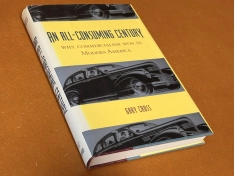
    An All-consuming Century

    An All-consuming Century

    Engelstalige hardcover met stofomslag, omslag iets verkleurd, verder nog in uitstekende staat. Trefw. Amerika, Verenigde Staten, USA, economie, cultuur.

    The unqualified victory of consumerism in America was not a foregone conclusion. The United States has traditionally been the home of the most aggressive and often thoughtful criticism of consumption, including Puritanism, Prohibition, the simplicity movement, the '60s hippies, and the consumer rights movement. But at the dawn of the twenty-first century, not only has American consumerism triumphed, there isn't even an "ism" left to challenge it. An All-Consuming Century is a rich history of how market goods came to dominate American life over that remarkable hundred years between 1900 and 2000 and why for the first time in history there are no practical limits to consumerism.

    By 1930 a distinct consumer society had emerged in the United States in which the taste, speed, control, and comfort of goods offered new meanings of freedom, thus laying the groundwork for a full-scale ideology of consumer's democracy after World War II. From the introduction of Henry Ford's Model T ("so low in price that no man making a good salary will be unable to own one") and the innovations in selling that arrived with the department store (window displays, self service, the installment plan) to the development of new arenas for spending (amusement parks, penny arcades, baseball parks, and dance halls), Americans embraced the new culture of commercialism-with reservations. However, Gary Cross shows that even the Depression, the counterculture of the 1960s, and the inflation of the 1970s made Americans more materialistic, opening new channels of desire and offering opportunities for more innovative and aggressive marketing. The conservative upsurge of the 1980s and '90s indulged in its own brand of self-aggrandizement by promoting unrestricted markets. The consumerism of today, thriving and largely unchecked, no longer brings families and communities together; instead, it increasingly divides and isolates Americans.

    Consumer culture has provided affluent societies with peaceful alternatives to tribalism and class war, Cross writes, and it has fueled extraordinary economic growth. The challenge for the future is to find ways to revive the still valid portion of the culture of constraint and control the overpowering success of the all-consuming twentieth century.

    Gary S. Cross ;

    € 7,50

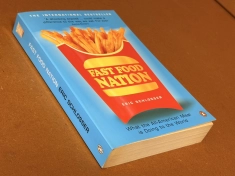
    Fast Food Nation. What...

    Fast Food Nation. What The All-American Meal is Doing to the World

    Mooi ex. Engelstalige paperback, als nieuw, like new.

    Now the subject of a film by Richard Linklater, Eric Schlosser's explosive bestseller Fast Food Nation: What the All-American Meal is Doing to the World tells the story of our love affair with fast food.

    Britain eats more fast food than any other country in Europe. It looks good, tastes good, and it's cheap. But the real cost never appears on the menu.

    Eric Schlosser visits the lab that re-creates the smell of strawberries; examines the safety records of abattoirs; reveals why the fries really taste so good and what lurks between the sesame buns - and shows how fast food is transforming not only our diets but our world.

    'Fast Food Nation has lifted the polystyrene lid on the global fast food industry ... and sparked a storm'
    Observer

    'Has wiped that smirk off the Happy Meal ... Thanks to this man, you'll never eat a burger again'
    Evening Standard

    'Startling ... Junk food, we learn, is just that ... left this reader vowing never to set foot in one of those outlets again'
    Daily Mail

    'This book tells you more than you really want to know when you're chomping on that hamburger ... Have a nice day? Listen - you should live so long'
    The Times

    Eric Schlosser is a correspondent for the Atlantic Monthly. His first book, Fast Food Nation, was a major international bestseller. His work has appeared in the Atlantic Monthly, Rolling Stone and the Guardian. He has received a number of journalistic honours, including a National Magazine Award for an Atlantic Review article on the drug trade, which was later adapted into the book Reefer Madness.

    Eric Schlosser ;

    € 3,99
    Bezig met laden...
    close

    Favorietenlijst